What is Audit Trail?
This website contains quality concepts of pharmaceutical industry and some of my personnel articles.
Search This Blog
AUDIT TRAIL AND ITS IMPORTANCE
Audit trail information required throughout the Data life cycle as follows.· Data generation and capture;· Data transmission;· Data processing;· Data review;· Data reporting, including handling of invalid and atypical data;· Data retention and retrieval; back-up & Archival· Data disposal.
DEVIATION MANAGEMENT
As part of quality management system (QMS), Deviation handling plays vital role in assuring quality of products and by contributing to continuous improvement.
Deviation is an undesirable event in the pharmaceutical manufacturing process that can affect product quality or contradict/omit requirements contemplated in the approved procedures.
Deviation categorizations:
-
Incidents
-
Minor Deviations
-
Major Deviations
-
Critical deviations
Incidents:
Incidents are undesirable events that have no effect on product quality and/or do not deviate requirements contemplated in an established standards.
Record the incidents in respective documents like batch records, log books, analytical data sheets as appropriate. It nevertheless need to be documented as separate QMS events.
Possible examples of Incidents as follows:
- Incidents
- Minor Deviations
- Major Deviations
- Critical deviations
- Temporary power failure in a warehouse where no temperature sensitive materials are stored, with no temperature excursion from the established range.
- Production process parameters or environmental monitoring data reach alert levels but are still within acceptable range.
Minor Deviations:
Minor deviations are undesirable events that have no effect on product quality but deviated contemplated requirements from established standards.
Minor deviations treated as such by applicable procedure.
Possible examples of minor deviations are given below: -
- Skip of FEFO (first expired-first out) and/ or FIFO (First in First out) principle in raw material handling.
- Balance out of tolerance used to determine gross weight of raw materials upon reception.
- Pressure differential out of established limits in class D washing area.
- Inadequately trained personnel to perform warehouse cleaning activities
Minor deviations requires documented objective evidence written in concise and clear way stating locations, person found the deviation and deviation details.
Minor deviations are normally addressed by Corrections after approval by QA which are taken to correct and contain the problem (including immediate actions), based on sufficient documented evidence.
Minor deviations do not necessarily require an investigation aimed at identifying the root causes of the problem as major and critical deviations do
Major Deviations:
Major deviations are undesirable events that effects product quality and impact to patient is unlikely and deviated contemplated requirements from established standards.
Major deviations requiring immediate action, investigation, and documented as such by the appropriate SOP
Possible examples of major deviations are given below: -
- Use of unapproved reference standard to test an API or drug product.
- Inadequately trained personnel to perform sterility tests.
- Production started without line clearance.
- Wrong calculation of assay values during raw material dispensing
- Failure to load or withdraw or analyses stability samples with in schedules.
- Filter integrity test has been carried out using equipment with no documented installation qualification completed.
- Gross misbehavior of staff in a critical aseptic process.
- Pressure differential out of established limits in aseptic fill areas.
- Operational parameter out of range for a parameter defined as non-critical.
- Untrained personnel responsible for segregating the approved and rejected raw material in the warehouse.
- Failure to calibrate / preventive maintenance of instruments or equipment’s in stipulated schedules
Critical Deviations:
Critical deviations are undesirable events that effects product quality and impact to patient is highly probable including life threatening situations and deviated contemplated requirements from established standards.
Critical deviations requiring immediate action, investigation, and documented as such by the appropriate SOP
Possible examples of major deviations are given below: -
- Expired or rejected API component used.
- Sterilization record of product-contact material used in aseptic filling process not available or unacceptable.
- Incomplete inactivation stage of fermentation
- Temperature out of control limit during detoxification stage.
- Product mix-up
- Breakdown of equipment during critical operations
Major or critical deviations usually require an enhanced, thorough and objective description which needs to be documented. An adequate description associated to the deviation is essential in order to perform a meaningful investigation.
Major or critical deviations would be typically first addressed by corrections, which would need QA approval as mentioned above. An investigation is then initiated on the root causes of the deviation, followed by the corresponding corrective actions.
If a minor deviation is repeated a significant number of times, it could turn into a major deviation, and must be treated as such. The investigation of the deviation should also determine the reason why the implemented corrective actions were not successful. Based on the same rationale, repetitions of one same incident can turn it into a minor deviation
Note:
The term “planned deviation” is frequently used to describe a decision to carry out a process in a different way from which it is established in a SOP, Method or Manufacturing Batch Record (e.g., a reprocess) due to an unforeseen event. Planned deviations need to be fully documented and justified. Usually, planned deviations associated to onetime events, and change control to permanent changes.
OUT OF SPECIFICATION RESULTS
All test results that fall outside the specifications or acceptance criteria established in drug applications, drug master files (DMFs), official compendia, or by the manufacturer including all in-process laboratory tests that are outside of established specifications.
Regulations require that an investigation to determine the cause of OOS results.
The source of OOS results should be identified either as an aberration of measurement process (Laboratory analysis) or an aberration of manufacturing process.
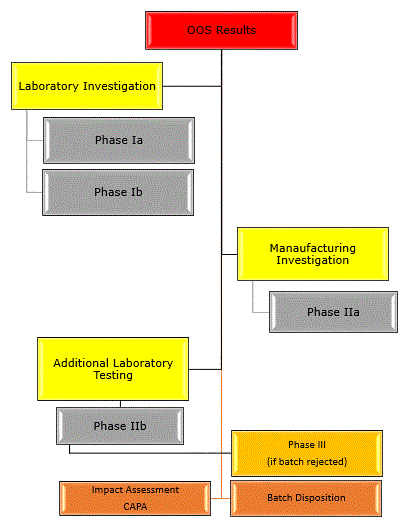
Obviously investigation starts from laboratory as OOS results generates from laboratory during testing. Investigation contains different phases as detailed below.
Analysts should check the data for compliance with test specifications before discarding test preparations or standard preparations. When unexpected results are obtained and no obvious explanation exists, test preparations should be retained, if stable, and the analyst should inform the supervisor for initiation of OOS investigation
Phase-1a Investigation:
The main purpose of Phase 1a investigation is to verify whether the generated OOS results are accurate, and the testing was performed without any deviation to respective testing procedure and practices.
Focus to be given to ensure no obvious errors occurred during the testing process.
Examples of obvious errors.
- Incorrect documents
- Incorrect samples, standard
- Incorrect or dirty glassware
- Calculation errors
- Power outage
- Equipment failure or Incorrect Instrument Parameters
- Preparation errors
- Non-qualified instruments or untrained analysts.
- Issues with environment temperature & Humidity
- Incorrect media or reagents, incorrect incubation times
The following steps should be taken as part of the Laboratory assessment:
- Discuss the test method with the analyst; confirm analyst knowledge of and performance of the correct procedure.
- Examine the raw data obtained in the analysis, including chromatograms and spectra, and identify anomalous or suspect information.
- Verify that the calculations used to convert raw data values into a final test result are scientifically sound, appropriate, and correct; also determine if unauthorized or unvalidated changes have been made to automated calculation methods.
- Confirm the performance of the instruments.
- Determine that appropriate reference standards, solvents, reagents, and other solutions were used and that they met quality control specifications.
- Evaluate the performance of the test method to ensure that it is performing according to the standard expected based on method validation data and historical data.
- Fully document and preserve records of this laboratory assessment.
- Review the history and evaluate the previous trends.
A basic hypothesis testing (Investigative analysis) with retained sample preparations can also be considered as part of Phase 1a investigation to identify what might have happened during analysis.
- Same vials can be re-injected, same vial re-injections can provide strong evidence that problem should be attributed instrument performance.
- Same solutions can be re-injected, reinjections of same solutions can provide strong evidence that the problem should be attributed to the instrument or vials, rather than the sample or its preparation.
- Solutions can be re-diluted from stock and re-injected, re-diluted re-injections can provide strong evidence that the problem should be attributed the sample or its preparation.
- Investigation shall be extended to Phase Ib, when the phase Ia investigations did not reveal an assignable laboratory error.
Phase-1b Investigation:
Phase 1b consists of detailed hypothesis testing (or) investigative analysis. i.e testing performed to help confirm or discount a possible root cause i.e what might have happened that can be tested:- Multiple hypothesis can be explored based on the suspection of Phase 1a investigation.
it may include but not limited to
- Testing regarding sample filtration, sonication /extraction to evaluate the impact on sample results and possibility of improper filtration, sonication/extraction
- Testing of spiked samples to confirm or discount the possibility of contamination.
- Examination of the original dosage unit to determine whether it was damaged during laboratory handling in a way that affected its performance for release rate testing of certain specialized dosage form drugs.
- Testing of retention/control samples or additional stability samples.
- Simulations with different preparations, different columns and different conditions based on suspection.
Phase 1b investigations should be driven by written and approved instructions against hypothesis. Description of the testing should be written, and then approved by QA/Contract Giver/QA equivalent prior to initiating investigative testing.
The requirements of investigative testing listed below:
The description must fully document
- The hypothesis to the test the root cause being investigated.
- What samples will be tested.
- The exact execution of the testing.
- How the data will be evaluated
Investigative testing may not be used to replace an original suspect analytical results. It may only be used to confirm or discount a probable cause.
In summary, when clear evidence of laboratory error exists, laboratory testing results should be invalidated. When evidence of laboratory error remains unclear, investigation should be extended to manufacturing firm to determine what caused the unexpected results. It should not be assumed that OOS test results are attributable to analytical error without performing and documenting an investigation. Both the initial laboratory assessment and the following OOS investigation should be documented fully.
A full-scale investigation should include a review of production and sampling procedures, and will often include additional laboratory testing
Phase IIa Investigation:
Phase IIa investigation consists of manufacturing investigation. Where all cross-functional departments like production, warehouse, vendors etc shall be communicated regarding OOS & laboratory investigation details to initiate investigation at their end as applicable.
Relevant functions shall review the following (but not limited to) to identify the, if any assignable cause
- Manufacturing process sequence and related critical parameters
- Review of executed manufacturing records
- Review of production activity to confirm that operator is properly trained and appropriate standard procedure, batch records are available and followed
- Review of calculations and computer generated data
- Review of performance of machine(s)/personnel(s) associated with the batch.
- Evaluation of storage & transportation of raw materials and samples used in the batch and nature of materials used in the batch.
- Evolution of sampling procedure
- Review of historical trends where applicable
- Impact on earlier supplies
- Vendor investigation report review where necessary
If this part of the OOS investigation confirms the OOS result and is successful in identifying its root cause, the OOS investigation may be terminated and the product shall be rejected.
Phase IIb Investigation:
Additional Laboratory testing involves retesting of the sample.
Retesting can be done from a portion of original sample. The sample used for the retesting should be taken from the same homogeneous material that was originally collected from the lot, tested, and yielded the OOS results. For a liquid, it may be from the original unit liquid product or composite of the liquid product; for a solid, it may be an additional weighing from the same sample composite prepared for the original test.
- If insufficient quantity of the original sample remains to perform all further testing then the procedure for obtaining a re-sample must be discussed and agreed by QA/Contract Giver/QA equivalent. The process of obtaining the re-sample should be recorded within the laboratory investigation.
- The decision to retest should be based on sound scientific judgement. The test plan must be approved before re testing occurs.
If original sample quantity is insufficient or investigation reveals sampling error then re-sampling shall be performed by the same qualified, validated methods that are used for initial sample collection.
The maximum number of retests to be performed on a sample should be specified in advance in a written standard operating procedure (SOP). The number may vary depending upon the variability of the particular test method employed, but should be based on scientifically sound principles.
The number of retests should not be adjusted depending on the results obtained. The firm's predetermined retesting procedures should contain a point at which the additional testing ends and the batch is evaluated. If the results are unsatisfactory at this point, the batch is suspect and must be rejected or held pending further investigation
After retesting,
OOS Confirmed:
If OOS results are confirmed then batch shall be rejected by reporting initial OOS results.
The investigation changes from an OOS investigation into a batch failure investigation, which must be extended to other batches or products that may have been associated with the specific failure as part of Phase III.
OOS Conclusive:
If retesting results found with in specification and assignable cause identified then report the retest results and invalidate the initial OOS results. CAPA shall be proposed accordingly and impact assessment shall be done.
OOS Inconclusive:
If retesting results found with in specification but no assignable cause identified then report all the results and decide on batch disposition.
All test results, both passing and suspect, should be reported (in all QC documents and any Certificates of Analysis) and all data has to be considered in batch release decisions
For inconclusive investigations — in cases where an investigation:-
(1) does not reveal a cause for the OOS test result and
(2) Does not confirm the OOS result
the OOS result should be given full consideration (most probable cause determined) in the batch or lot disposition decision by the certifying QP and the potential for a batch specific variation also needs considering.
Any decision to release a batch, in spite of an initial OOS result that has not been invalidated, should come only after a full investigation has shown that the OOS result does not reflect the quality of the batch. In making such a decision, Quality Assurance/QP should always err on the side of caution.
The QA might still ultimately decide to release the batch. For example, a firm might consider release of the product under the following scenario:
A product has an acceptable composite assay range of 90.0 to 110.0 percent. The initial (OOS) assay result is 89.5 percent. Subsequent sample preparations from the original sample yield the following retest results: 99.0, 98.9, 99.0, 99.1, 98.8, 99.1, and 99.0 percent.
A comprehensive laboratory investigation (Phase 1) fails to reveal any laboratory error.
Review of events during production of the batch reveals no aberrations or indication of unusual process variation. Review of the manufacturing process and product history demonstrates that the process is robust.
The passing retest results are all well within the known limits of variability of the method used. Batch results from in-process monitoring, content uniformity, dissolution, and other tests are consistent with the passing retest results.
After a thorough investigation, a firm’s QA might conclude that the initial OOS result did not reflect the true quality of the batch.
It is noteworthy in this scenario that the original, thorough laboratory investigation failed to find any assignable cause. However, if subsequent investigation nonetheless concludes that the source of the OOS result was a cause unrelated to the manufacturing process, in response to this atypical failure to detect the laboratory deviation, it is essential that the investigation include appropriate follow-up and scrutiny to prevent recurrence of the laboratory error(s) that could have led to the OOS result.
As the above example illustrates, any decision to release a batch, in spite of an initial OOS result that has not been invalidated, should come only after a full investigation has shown that the OOS result does not reflect the quality of the batch.
INTERVIEW QUESTIONS
1. HR (HUMAN RESOURCE) INTERVIEW QUESTIONS
2. QUALITY CONTROL INTERVIEW QUESTIONS ON WET CHEMICAL ANALYSIS
3. QUALITY CONTROL INTERVIEW QUESTIONS ON WET INSTRUMENTAL ANALYSIS
4. QUALITY CONTROL INTERVIEW QUESTIONS ON CHROMATOGRAPHY
5. INTERVIEW QUESTIONS ON SYSTEM SUITABILITY PARAMETERS - HPLC & GC
6. INTERVIEW QUESTIONS ON TROUBLESHOOTING - HPLC & GC
CHANGE MANAGEMENT SYSTEM
In any organization change in the system, process and
procedures is natural as part of continuous improvements.
A formal change management (change control) system should be
established as an integral part of a Quality Management System (QMS) of the
organization to ensure that all the changes are appropriately identified,
planned, documented, evaluated, approved & regulated.
There should be written procedures in place for technical &
scientific evaluation and potential impact of the proposed changes on the
quality of the medicinal products and other possibly affected systems.
Any proposals for GMP relevant changes should be drafted, reviewed, and
approved by the appropriate organizational units, and by the quality unit(s).
Assign personnel responsible for initiation, review and approval of the
specific steps of the change. It needs to be noted that a change proposal may
be expanded, modified or rejected, based on the evaluation performed during the
approval process.
There
should be traceable system for change log like identification code or number
can be assigned.
Following steps could be considered during the process of change
control.
2. Change review
3. Change classification & Approval
4. Change Implementation plan & Implementation
5. Review the implemented change
6. Effectiveness verification & Closure
- The respective personnel from the department initiate the change proposal by detailing proposed procedure/ process/ system against to the current procedure/ process/ system.
- Following should be part of change proposal
¾ Change
related to (documents/ Facility/
process/ equipment/ software/ product…etc)
¾ Current
system
¾ Proposed
system
¾ Reason
for the proposed change
¾ Risk
of the proposed change
¾ Impacted
documents/ systems/ process...etc
- There should be proper reason or
justification with documented evidence for the proposed change
- The risk of the each proposed change to be
evaluated in a systematic way. The risk of changes like new facility
establishment, new product introduction, process equipment modification/
replacement, change in manufacturing process, change in the API source, lab
application software up gradation…etc shall be assessed in a formalized manner
by using risk assessment techniques like FMEA.
- Few companies has a practice of change
classification (Minor/ Major/ Critical) at this stage by change initiator, but
as per me it should be at change approval stage by QA as defined in the
respective section.
- Few companies has a practice of providing
anticipated date of change implementation at this stage but as per me it should
be after change approval as defined in respective section.
2. Change review:
- The proposed change shall be reviewed by all
concerned personnel for adequacy.
- Starting from change initiator department
head followed by related cross-functional department representatives and
finally QA shall review the proposed change as part evaluation.
- QA holds the responsibility to identify the
Cross-functional department representatives (i.e functional subject matter
experts) that are required to evaluate the proposed change based on the type of
proposed change.
- It is better to have provision in your change
control SOP that states common proposed changes and required cross-functional
departments as part of review process
- Finally QA designee hold specific
responsibility to evaluate and assess the proposed change to identify all
impacted systems/ processes /procedures w.r.t following but not limited to
¾ SOP’s
¾ Specifications/
STP
¾ MFR
(Master formulae record), BMR (Batch manufacturing record), BPR (Batch packing
records)
¾ Site
master file & Validation master plan
¾ Qualification
/Validation
¾ Drawing/
Layouts
¾ Stability
studies
¾ Approved
vendors/ testing laboratories
¾ Trainings
- As a part of the
evaluation process, the need to obtain approval from or to notify the change to
authorities and/or customers, must be evaluated.
- The potential for
critical changes to affect established retest or expiry dates should be
evaluated. If necessary, samples of the medicinal products produced by the
modified process can be placed on an accelerated stability program and/or can
be added to the stability monitoring program.
- Current dosage
form manufacturers should be notified of changes from established production
and process control procedures that can impact the quality of the API.
3. Change classification & Approval
- Finally
QA head evaluate change proposal and classify the change and approve the same.
- Changes can be classified (e.g. as minor/ major/
critical) depending on the nature and extent of the changes, and the effects of
these changes may impart on the process. A classification procedure may help in
determining the extent of document review, testing, validation and
documentation needed in line with the proposed change.
- The classification should be based on sound
justification based on the risk to product quality.
Minor
: Do not have any impact on product quality attributes
Major
: Likely to have indirect minor impact on product quality attributes
Critical:
Have significant impact on product quality attributes.
- After
the approval of change control by QA Head, the change implementation plan shall
be made.
- The
change implementation plan should contain following as a minimum criteria.
¾
Number
changes to be done
¾
Responsible
persons for each change
¾
Anticipated
completion date for each change
- As
per the change implementation plan, all the proposed changes shall be done with
the anticipated dates if not extension to the anticipated dates can be taken
with proper justification.
- When implementing approved changes, measures
should be taken to ensure that all documents affected by the changes are
revised.
- After the change has been implemented, there
should be an evaluation of the first batches produced or tested under the
change.
- After
completion implementation of all changes, the change initiator notifies QA for
further verification and closure.
5. Review of the implemented change
- QA
verifies each implementation against proposal.
- If
found satisfactory, assess the requirement for effectiveness verification after
certain period of time (after one month, two months, three months. Etc).
- If
effectiveness verification not required, change control shall be closed.
- If
effectiveness verification is required the verification plan shall be made.
6. Effectiveness verification & Closure
- As per the effectiveness verification plan, QA designee verifies the effectiveness of implemented changes and if found satisfactory and close the change control.
Subscribe to:
Posts (Atom)